After moving to the Linux 7.0 kernel (
Setting
The same failure the same guest-side signature has since appeared on a second, completely unrelated host: different hardware, different storage backend, different guest workload, same PVE 9.2.3 / 7.0.6-2-pve. The only common denominator is the software stack (PVE 9.2.3 / kernel 7.0.6-2-pve, with the default io_uring backend).
This is a functional data-availability bug (guests lose their disks under normal load).
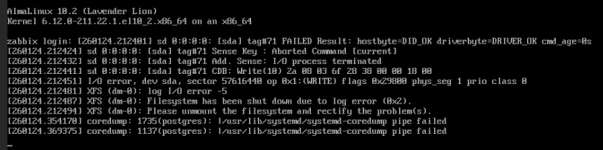
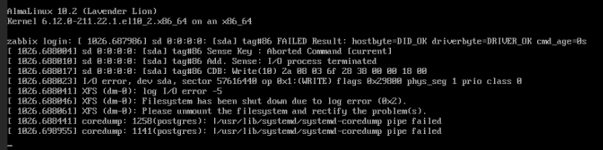
Here are screenshots of failed console of affected VMs :
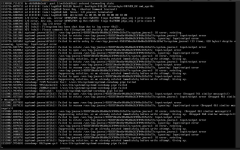
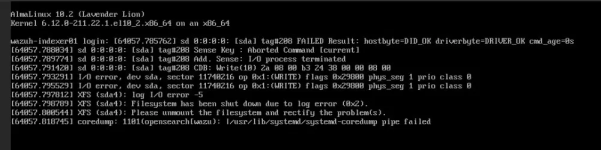
Does anyone can help me ?
Thank you.
7.0.6-2-pve) that became the new default with PVE 9.2.x, I encounter I/O failures on some VMs on the host and it starts throwing hard I/O errors (EIO) on its virtual disk, which makes the guest filesystem abort and shut down. The host itself reports no disk, mdadm, dm-crypt/LUKS or LVM errors — SMART is clean and the underlying storage is healthy. The exact same VMs, on the exact same storage, run flawlessly on the previous kernel 6.17.13-2-pve.Setting
aio=threads on the affected disks does not solved the issue while staying on 7.0.6-2-pve. Toggling only the aio backend (io_uring ↔ threads), changing nothing else.The same failure the same guest-side signature has since appeared on a second, completely unrelated host: different hardware, different storage backend, different guest workload, same PVE 9.2.3 / 7.0.6-2-pve. The only common denominator is the software stack (PVE 9.2.3 / kernel 7.0.6-2-pve, with the default io_uring backend).
This is a functional data-availability bug (guests lose their disks under normal load).
Here are screenshots of failed console of affected VMs :
Does anyone can help me ?
Thank you.
Last edited: