

Hello,
I have a three-node cluster with two rings.
1. One full ring between the three nodes. Similar to the configuration shown here:
https://pve.proxmox.com/wiki/Full_Mesh_Network_for_Ceph_Server#Example
2. And one "uplink" ring of the "e0np0" interfaces as shown here (derived picture from the wiki-topology with the additional ring):
Image with the full topology (forget about the IPMI network here)
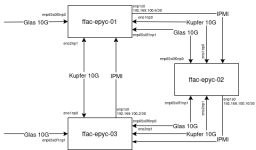
So as ceph is working well with this setup, just as documented here:
https://pve.proxmox.com/wiki/Full_Mesh_Network_for_Ceph_Server#Example
The question which is still open is:
How to manage the VM IP Addresses running on these hosts.
1. node1 and node3 have direct access to the uplink - can therefore put VMs into their vmbr0 and be done
2. node2 does not have direct access and must be routed via epyc03 and/or epyc01 - the VMs on this host should be able to use public IPs from the uplink broadcast domain.
How we currently solve this:
1. node03 puts e0np0 and e1np1 into vmbr0
2. node02 puts e1np1 into vmbr0
3. all VMs are on the respective vmbr0
Alternative option:
- just buy a switch and get proper uplink configured for node02 as well
I wonder what options are possible for such a setup. I prefer using onboard SDN EVPN stuff, but am also interested in other options and ideas for this problem.
I have a three-node cluster with two rings.
1. One full ring between the three nodes. Similar to the configuration shown here:
https://pve.proxmox.com/wiki/Full_Mesh_Network_for_Ceph_Server#Example
2. And one "uplink" ring of the "e0np0" interfaces as shown here (derived picture from the wiki-topology with the additional ring):
Code:
      (WAN) |       ┌───────────┐        | (WAN)
            |       │   Node2   │        |
            |       ├─────┬─────┤        |
            |     ┌─┤e0np0│e1np1├─┐      |
            |     | ├─────┬─────┤ |      |
            |     | │eno21│eno10│ |      |
            |     | └──┬──┴──┬──┘ |      |
            |     │    │     │    |      |
┌───────┬─────┐   │    │     │    │   ┌─────┬───────┐
│       │e0np0│   │    │     │    │   │e0np0│       │
│       ├─────┤   │    │     │    │   ├─────┤       │
│       │e1np1├───┘    │     │    └───┤e1np1|       │
│       ├─────┤        │     │        ├─────┤       │
│       │eno10├────────┘     └────────┤eno21│       │
│ Node1 ├─────┤                       ├─────┤ Node3 │
│       │eno21├───────────────────────┤eno10│       │
└───────┴─────┘                       └─────┴───────┘
Image with the full topology (forget about the IPMI network here)
So as ceph is working well with this setup, just as documented here:
https://pve.proxmox.com/wiki/Full_Mesh_Network_for_Ceph_Server#Example
The question which is still open is:
How to manage the VM IP Addresses running on these hosts.
1. node1 and node3 have direct access to the uplink - can therefore put VMs into their vmbr0 and be done
2. node2 does not have direct access and must be routed via epyc03 and/or epyc01 - the VMs on this host should be able to use public IPs from the uplink broadcast domain.
How we currently solve this:
1. node03 puts e0np0 and e1np1 into vmbr0
2. node02 puts e1np1 into vmbr0
3. all VMs are on the respective vmbr0
Alternative option:
- just buy a switch and get proper uplink configured for node02 as well
I wonder what options are possible for such a setup. I prefer using onboard SDN EVPN stuff, but am also interested in other options and ideas for this problem.

