No.Any issue with me upgrading just one node on my 2-node cluster?
As long as you like.How long/can they run at different kernel versions?


No.Any issue with me upgrading just one node on my 2-node cluster?
As long as you like.How long/can they run at different kernel versions?

Hi Jan,
On 7/1/26 19:13, Jan Hendrik Farr wrote:
The code to create the binary firmware file is at:Hi Birger,
it looks like the firmware file rtl_nic/rtl8159-1.fw isn't in linux-firmware yet.
Could you send it for people to potentially test?
Jan
https://gitlab.com/koblitz-rtlnic/rtlnic_fw
But I cannot submit the firmware itself to linux-firmware, as the sourcecode from
which the binary data is extracted is published by Realtek under the GPL.
For linux-firmware, a binary distribution license is necessary, which requires
someone from Realtek to license it under their usual firmware license. I
contacted Realtek, but never heard back.
Cheers,
Birger

could you provide the system logs/journal for the relevant boots, i.e. one with 7.3.5 and one with 7.3.6 as well as the output ofDid anybody else lose ATA naming in /dev/disk/by-id?
Worked fine in 7.3.5. Upgraded to 7.3.6 and now a bunch of my drives don't have their ATA names anymore. I can see them there by scsi- and by wwn-. But ata-... is now gone.
I'll add that the NVMe's still have their ata names for some reason. Seems to only affect drives that are on a controller via mpt3sas
lspci -nnk for each one?Possibly something linked to these NEW packages which were recently added (no-subscription)? :We're taking a closer look at some specific NVMe multipath behavior, but it doesn't appear to be kernel-specific.
2026-11-24

kpartx libnvme1t64 libsgutils2-1.48 multipath-tools nvme-cli sg3-utils sg3-utils-udev
From my output yesterday on one node, (& similar on another node today):no, these are just updates.
Starting system upgrade: apt-get dist-upgrade
Reading package lists... Done
Building dependency tree... Done
Reading state information... Done
Calculating upgrade... Done
The following NEW packages will be installed:
  kpartx libnvme1t64 libsgutils2-1.48 multipath-tools nvme-cli sg3-utils sg3-utils-udev uuid-runtime
The following packages will be upgraded:
  libproxmox-rs-perl libpve-access-control libpve-cluster-api-perl libpve-cluster-perl
  libpve-common-perl libpve-guest-common-perl libpve-network-api-perl libpve-network-perl
  libpve-notify-perl libpve-rs-perl libpve-storage-perl libzstd1 proxmox-archive-keyring
  proxmox-firewall proxmox-kernel-helper proxmox-mail-forward proxmox-widget-toolkit
  pve-cluster pve-container pve-docs pve-firewall pve-ha-manager pve-i18n pve-manager
  pve-notify-worker pve-yew-mobile-i18n qemu-server zstd
28 upgraded, 8 newly installed, 0 to remove and 0 not upgraded.
Need to get 33.6 MB of archives.Ah, sorry, I misunderstood. The new Recommends from pve-storage to multipath-tools for the SAN guided setup integration pulled this in as dependencies. TheSo something must have changed with dependencies, at the least a dependency transition (software package split)?Code:
sg3-utils-udev ships an udev rule file that takes precedence over an existing one (60-persistent-storage.rules) and can cause change in behavior for some disks, FWICT mostly those behind a SAS HBA like mpt3sas / megaraid_sas see this.1.48-3+pmx3 of that package, which ships a change for this https://git.proxmox.com/?p=package-...ff;h=5cbc8d74b0a6d20a4c17ee7b28f8f373258c4f97 basically going back to the behavior of the 60-persistent-storage.rules rules again for these, which are basically a super set of behavior (same wwn links but also correct by-id/serial ones for these SAS HBA attached disks).multipath-tools you could also remove that package and the sg3-utils-udev one.| Kernel | tx_hdr_buf_max |
|---|---|
| 7.0.14-29-pve | Present |
| 7.0.14-30-pve | Present |
| 7.3.6-1-pve | Absent |
kernel: bluetooth hci0: Direct firmware load for mediatek/BT_RAM_CODE_MT7902_1_1_hdr.bin failed with error -2
kernel: Bluetooth: hci0: Failed to load firmware file (-2)
pve kernel: Bluetooth: hci0: Failed to set up firmware (-2)
pve kernel: Bluetooth: hci0: HCI Enhanced Setup Synchronous Connection command is advertised, but not supported.View attachment 102876
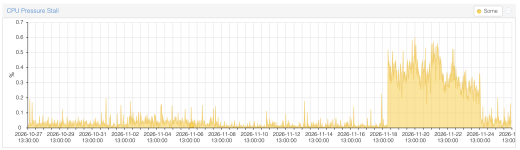
You can clearly see the difference for the new Kernel 7.3.5-1.
CPU: 128 x AMD EPYC 9554 64-Core Processor (1 Socket)
nouveau 0000:01:00.0: fb: 0 MiB GDDR5
nouveau 0000:01:00.0: bus: MMIO read of 00000000 FAULT at 6013d4 [ PRIVRING ]
nouveau 0000:01:00.0: timeoutoptions vfio-pci ids=10de:1b38
softdep nouveau pre: vfio-pciI do not have a NVIDIA card, but I don't know wether or not you use hook scripts. But I had to change my hook scripts, due to kernel 7.3's tighter security, as it does not give root full access to PCI.Has anyone seen a similar nouveau initialization failure on Pascal with 7.3? I can provide sanitized kernel logs and task stacks if useful.
#!/bin/bash
# /var/lib/vz/snippets/gpu-hook.sh
# Proxmox GPU Recovery Hook — proven on 7.3.5-1-pve with Navi 21
#
# Only runs on post-stop. Recovers devices passed through to this VM.

VMID="$1"
PHASE="$2"

log() { echo "[VM $VMID GPU Recovery] $*"; }

log "HOOK CALLED – VM: $VMID  Phase: $PHASE  Time: $(date +'%Y-%m-%d %H:%M:%S')"

if [[ "$PHASE" != "post-stop" ]]; then
    log "Skipping recovery ($PHASE is not post-stop phase)"
    exit 0
fi

log "Starting GPU recovery (post-stop phase)"

# ====================== Extract PCI devices from VM config ======================
RAW_PCI=$(qm config "$VMID" --current 2>/dev/null |
          grep '^hostpci' |
          grep -Eio '([0-9a-fA-F]{4}:)?[0-9a-fA-F]{2}:[0-9a-fA-F]{2}(\.[0-7])?' |
          sort -u)

PCI_DEVS=""

for base in $RAW_PCI; do
    if [[ "$base" =~ ^[0-9a-fA-F]{2}: ]]; then
        base="0000:$base"
    fi
    if [[ "$base" != *.* ]]; then
        PCI_DEVS="$PCI_DEVS $base.0 $base.1"
    else
        PCI_DEVS="$PCI_DEVS $base"
    fi
done

PCI_DEVS=$(echo "$PCI_DEVS" | tr ' ' '\n' | sort -u | tr '\n' ' ' | xargs)

[[ -z "$PCI_DEVS" ]] && { log "No PCI passthrough devices found for this VM."; exit 0; }

log "Detected PCI devices for recovery: $PCI_DEVS"

# ====================== Helpers ======================
is_on_amdgpu() {
    lspci -nnk -s "$1" 2>/dev/null | grep -q "Kernel driver in use: amdgpu"
}

is_video_device() {
    lspci -nn -s "$1" 2>/dev/null | grep -qE '\[0300\]|\[0302\]' || \
    lspci -s "$1" 2>/dev/null | grep -qiE 'VGA compatible controller|3D controller'
}

unbind_device() {
    local dev="$1"
    echo "" > "/sys/bus/pci/devices/$dev/driver_override" 2>/dev/null || true
    echo "$dev" > /sys/bus/pci/drivers/vfio-pci/unbind 2>/dev/null || true
    if [[ -L "/sys/bus/pci/devices/$dev/driver" ]]; then
        echo "$dev" > "/sys/bus/pci/devices/$dev/driver/unbind" 2>/dev/null || true
    fi
}

# ====================== Main Recovery ======================
for DEV in $PCI_DEVS; do
    if is_on_amdgpu "$DEV"; then
        log "Skipping $DEV — already bound to amdgpu"
        continue
    fi

    if is_video_device "$DEV"; then
        log "Recovering GPU $DEV (Navi/RDNA path)"
        AUD="${DEV%.0}.1"

        # 1. Unbind both functions and clear override
        log "  unbind and clear override"
        unbind_device "$DEV"
        [[ -n "$AUD" && -e "/sys/bus/pci/devices/$AUD" ]] && unbind_device "$AUD"

        # 2. Prefer amdgpu on the next probe
        log "  set driver_override to amdgpu"
        echo amdgpu > "/sys/bus/pci/devices/$DEV/driver_override" 2>/dev/null || true

        # 3. Remove + rescan
        log "  remove + rescan"
        echo 1 > "/sys/bus/pci/devices/$DEV/remove" 2>/dev/null || true
        sleep 2
        echo 1 > /sys/bus/pci/rescan
        sleep 3

        # 4. If vfio-pci reclaimed it, kick it off
        if [[ -L "/sys/bus/pci/devices/$DEV/driver" ]] && \
           [[ "$(basename "$(readlink -f /sys/bus/pci/devices/$DEV/driver)")" == "vfio-pci" ]]; then
            log "  vfio-pci reclaimed $DEV, unbinding again"
            echo "$DEV" > /sys/bus/pci/drivers/vfio-pci/unbind 2>/dev/null || true
            sleep 1
        fi

        # 5. Clear override and bind to amdgpu
        echo "" > "/sys/bus/pci/devices/$DEV/driver_override" 2>/dev/null || true
        modprobe amdgpu 2>/dev/null || true

        log "  binding $DEV to amdgpu"
        if echo "$DEV" > /sys/bus/pci/drivers/amdgpu/bind 2>/dev/null; then
            if is_on_amdgpu "$DEV"; then
                log "  SUCCESS: $DEV recovered"
            else
                log "  WARNING: bind returned success but driver is not amdgpu"
            fi
        else
            log "  FAILED: could not bind $DEV to amdgpu"
        fi

        # Audio is left unbound (best-effort only if you need it later)
    else
        # Non-GPU devices (audio, etc.) — just release them
        log "Releasing $DEV from vfio-pci"
        unbind_device "$DEV"
    fi
done

log "GPU recovery complete for VM $VMID"
exit 0We use essential cookies to make this site work, and optional cookies to enhance your experience.