Proxmox Virtual Environment now available for 64-bit ARM (arm64)!

This may be useful information for some:


Blockbridge : Ultra low latency all-NVME shared storage for Proxmox - https://www.blockbridge.com/proxmox
 
Additional tech-note for ARM platform:


Blockbridge : Ultra low latency all-NVME shared storage for Proxmox - https://www.blockbridge.com/proxmox
 
  • Like
Reactions: Johannes S
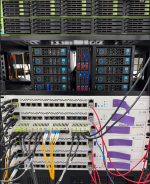
I spent this summer building a custom kernel for the MikroTik CCR2116 router and the RDS2216 server. Both use the Annapurna Labs Alpine AL73400, which is a 16-core 2GHz ARMV8-A processor (used in Amazon Graviton 1), with 16 or 32GB of RAM. I got the PXVirt port working on both platforms, and eventually settled with TrueNAS as a VM on the 2116's (with some NVME->SATA adapters and external drives) and TrueNAS installed on the bare metal on the RDS2216.

Just came across this announcement and thread, and got my Ampere server updated. Then I took a CCR2116 in the lab that had Bookworm staged on it. I upgraded it to Trixie, then installed PVE9.

I'll start testing VM's on it, then I plan to upgrade my cluster of 5 CCR2116's by migrating them from PXVirt (8.x) to PVE9. (Three are running Ceph, which works very well.)

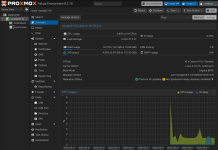
Screenshot 2026-09-21 at 6.18.04 PM.png
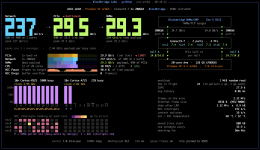
Screenshot 2026-09-21 at 6.21.45 PM.png
 
Last edited:
  • Like
Reactions: Johannes S and UdoB
Welcome to the Proxmox VE 9.2 (ISO 1) installer!
initial setup startup
mounting proc filesystem
mounting sys filesystem
EFI boot mode detected, mounting efivars filesystem
boot comandline: BOOT_IMAGE=/boot/linux26 ro ramdisk_size=16777216 rw quiet splash=silent
loading drivers: i2c_rk3x pwm_rockchip phy_rockchip_usbdp gpio_rockchip pinctrl_rockchip simple_pm_bus 8250_dw fixed ohci_platform phy_rockchip_naneng_combphy arm_smmu_v3 phy_rockchip_inno_usb2 ehci_platform spi_rockchip adc_keys phy_rockchip_samsung_hdptx rtc_efi dw_mmc_rockchip rockchip_thermal dw_wdt sdhci_of_dwcmshc rockchip_dfi rockchip_rng nvmem_rockchip_otp phy_rockchip_snps_pcie3 arm_smccc_trng efi_pstore cpufreq_dt dwc3 scmi_module scmi_transport_smc spi_rockchip_sfc sm4_ce_gcm ghash_ce aes_ce_blk
modprobe: FATAL: Module simple_pm_bus not found in directory /lib/modules/7.0.14-6-pve
modprobe: ERROR: could not insert 'adc_keys': Unknown symbol in module, or unknown parameter (see dmesg)
modprobe: ERROR: could not insert 'dwc3': Unknown symbol in module, or unknown parameter (see dmesg)
modprobe: ERROR: could not insert 'sm4_ce_gcm': No such device
modprobe: FATAL: Module mac_hid not found in directory /lib/modules/7.0.14-6-pve
searching for block device containing the ISO proxmox-ve-9.2-1
with ISO ID '019fce81-cf67-77df-970e-40e427c73a96'
testing again in 1 seconds
testing again in 2 seconds
testing again in 3 seconds
testing again in 4 seconds
testing again in 5 seconds
testing again in 6 seconds
testing again in 7 seconds
testing again in 8 seconds

[ERROR] no device with valid ISO found, please check your installation medium
unable to continue (type exit or CTRL-D to reboot)

my orange pi 5 plus w edk2 uefi

 
щкфтпу
That's the actual issue. How did you create the installer medium?
i conect ttl converter to uart board console
for see hidden process over turn off display
after 2 sec start install display off
i download official ISO ARM64 from proxmox.com
3-4 downloads same file, and use other USB flash..
i not understand what problem
first i find same problem via video out off and edit GRUB linux add line console=tty0
and today i think this no problem, problem about many errors drivers
i ready wait next ISO 9.2.2 i think to resolve problem
 
Last edited:
Does this mean we can now run a vanilla android version without a secondary emulation layer inside the VM ?
 
Hi,


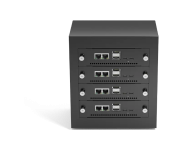
I would like to test the new Proxmox VE 9.2 ARM64 release on a Mixtile Cluster Box populated with Mixtile Blade 3 nodes:


  • Mixtile Cluster Box: https://www.mixtile.com/cluster-box/
  • Mixtile Blade 3
  • Rockchip RK3588 (ARM64 / ARMv8.2-A)
  • 32 GB RAM per node
  • Multiple Blade 3 nodes available, so I can also test PVE clustering

I understand from the announcement that ARMv8-A hardware may work on a best-effort basis, but Proxmox requires the host to boot via UEFI and expose the hardware through ACPI rather than being device-tree-only.


Has anyone already tried Proxmox VE 9.2 ARM64 on the Mixtile Blade 3 or another RK3588-based platform?


In particular, I would like to understand:


  1. Is there a working UEFI/EDK2 + ACPI implementation for the Mixtile Blade 3 that is suitable for Proxmox VE?
  2. Has anyone successfully booted the official Proxmox VE 9.2 ARM64 ISO on RK3588?
  3. Are there any known issues with networking, NVMe/PCIe, eMMC, or KVM virtualization on RK3588 with the Proxmox kernel?
  4. If the official ISO cannot boot directly, would installing Debian 13 ARM64 first and then installing Proxmox VE packages be a viable approach on this hardware?

I have the hardware available and would be happy to help with testing and debugging and provide any required logs.


If this platform is interesting for testing, I can also provide the Proxmox developers with remote IP-KVM access to one of the Mixtile Blade 3 nodes, including virtual media/ISO mounting, so they can boot images, install/test Proxmox VE, and debug the platform directly.


Thanks!
Artem Goncharenko

1790768341503.png
 
  1. Is there a working UEFI/EDK2 + ACPI implementation for the Mixtile Blade 3 that is suitable for Proxmox VE?
  2. Has anyone successfully booted the official Proxmox VE 9.2 ARM64 ISO on RK3588?
  3. Are there any known issues with networking, NVMe/PCIe, eMMC, or KVM virtualization on RK3588 with the Proxmox kernel?
  4. If the official ISO cannot boot directly, would installing Debian 13 ARM64 first and then installing Proxmox VE packages be a viable approach on this hardware?

If you can boot the kernel and load Debian using whatever mechanism you have available (u-boot, TFTP, etc.), it will run. The linked Raspberry Pi tutorial is what I used for the MikroTik routers.
 
A new article finally showing what a small ARM box running PVE is capable of:


Blockbridge : Ultra low latency all-NVME shared storage for Proxmox - https://www.blockbridge.com/proxmox