It's pretty well known, I can't find anything that states otherwise
Absence of evidence isnt evidence of absence.
but google is pretty easy to find more.
Searching for evidence after making a claim is backwards.
your google searches arent even informative- the toms hardware is breathless marketing without ANY substance. the Unihost article discusses theory, not actual metal. and I wont even dignify an article on linkedin with a comment; if you dont understand why I dont think anything I say would be convincing to you. There is no question that in the right circumstance and workload ARM makes perfect sense, but only at scale; Amazon, Microsoft, and Google all have enough for a bespoke design to make sense- but the only part commercially available is Ampere Altra. You dont need any think pieces, you have access to datasheets:
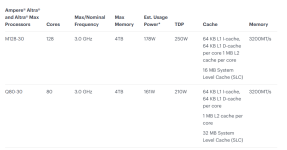
Even if I was to compare it to a DDR4 generation part, say an Epyc 7713P (64C/128T) which has a 225W TDP and will outperform the Q80 in virtually any load and the MI128-30 in most loads. For any load that requires single thread performance, that generation ARM is a non starter at all.
But thats not the worst of it. Once adding 8 channels of DDR4 ram, 128 PCIe lane retimers, NICS, HBAs, etc, the power difference is nearly meaningless. the Epyc part will be cheaper to obtain and run standard loads, would be able to participate in clusters with other hardware, will have standardized kernel and driver stack, etc etc etc.
If I was to compare it to SOTA, either Bergamo/Turin Dense or Intel Xeon 6 Sierra Forest would run circles around those ARM designs. Your original "its pretty well known" assertion suffers time decay.




