Latest activity
-
OOnslow reacted to longer's post in the thread [TUTORIAL] Using a TCP/Telnet Serial Console for Proxmox VMs with
 Like.
. As mentioned in the Serial Terminal wiki [0], you can configure a VM's serial console to listen on a local TCP port instead of the default socket: By doing this, the Proxmox VE host exposes the VM's serial console through a raw TCP socket...
Like.
. As mentioned in the Serial Terminal wiki [0], you can configure a VM's serial console to listen on a local TCP port instead of the default socket: By doing this, the Proxmox VE host exposes the VM's serial console through a raw TCP socket... -
OOnslow reacted to JohnnieKF's post in the thread Clocksource error when live migrating VM with Like.
Since you haven't measured anything yet, I'd confirm there's a real problem before chasing the message. In the guest, run this before a migration and again straight after: chronyc tracking Watch System time and Last offset. If both stay small...
-
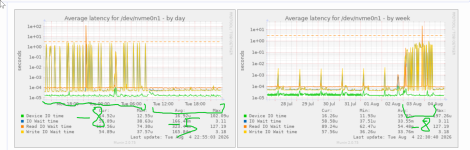
Wweppa replied to the thread Opt-in Linux 7.0 Kernel for Proxmox VE 9 available.This creates spikes that are well above munin defaults for sending emails. And these defaults are set by munin maintainers ? It's 0:3 by default (warning/email if above 3 seconds). It's like that since 20 years I believe... WARNINGs: Write IO...
-
Eechelon replied to the thread Slow speed on second bridge.Nothing useful in dmesg : root@pve:~# dmesg | grep igc [ 0.883537] igc 0000:04:00.0: enabling device (0000 -> 0002) [ 0.883670] igc 0000:04:00.0: PCIe PTM not supported by PCIe bus/controller [ 0.937020] igc 0000:04:00.0 (unnamed...
-
Gglaeken2 replied to the thread Kernel 7.0.x - Windows VMs freezing with cpu high 60-70%, newer cpus?.This is a side-topic, not related to the problem directly: Qemu has a watchdog, called i6300esb - which should reboot a frozen vm. config: watchdog: model=i6300esb,action=reset (not officially supported in proxmox) But don't bother, it doesn't...
-
Wweppa replied to the thread Opt-in Linux 7.0 Kernel for Proxmox VE 9 available.If this ever gets to a kernel developer : this is super easy to replicate ; just add munin package on a vm or LXC, or even on the host itself. monitoring disk latency is default. pve devs say for -6 update submodules and patches to...
-
Gglaeken2 replied to the thread Kernel 7.0.x - Windows VMs freezing with cpu high 60-70%, newer cpus?.I just now had to downgrade on production from 7.x to 6.x I tested q35, ver 11.0+pve2, cpu qemu x86-64 v3 - still freezes, this time at 80% cpu (so the range is now 40% - 80%) So this is not related: "The patch is already included in QEMU Server...
-
Wweppa replied to the thread Opt-in Linux 7.0 Kernel for Proxmox VE 9 available.I'm back at -5 and the problem vanished . So basically the problem appeared in -6 (as per Galaxis) , is still there in -8, I was just a bit late in the game. If it's a new kernel feature and not the sign of the disks getting crazy, it sure...
-
-
Rryzenixx replied to the thread I made a small native macOS menu bar app for Proxmox VE.Hey! Sorry, I completely missed your reply, and I apologize for getting back to you so late. Unfortunately, I'm primarily a macOS developer and don't have a Windows machine. Also, I have to admit that C# isn't really my favorite language to work...
-
Wweppa reacted to Galaxis's post in the thread Opt-in Linux 7.0 Kernel for Proxmox VE 9 available with Like.
Since @weppa writes it was still fine in -5 (which I skipped coming from -4), and the effect first showed up for me in -6, something must have happened between those two versions.
-
GGalaxis reacted to weppa's post in the thread Increased latency on disks since 9.2.6 and associated 7.0.x kernel with Like.
Thanks @Neobin ! In the meantime proxmox-boot-tool kernel pin 7.0.14-5-pve proxmox-boot-tool refresh UPDATE : I can confirm the problem DISAPPEARS with kernel 7.0.14-5 So it's specific to kernels after this one.
-
GGalaxis replied to the thread Opt-in Linux 7.0 Kernel for Proxmox VE 9 available.Since @weppa writes it was still fine in -5 (which I skipped coming from -4), and the effect first showed up for me in -6, something must have happened between those two versions.
-
J_--James--_ replied to the thread ProxmoxVE and the shared root account for update/upgrades..I agree that GitOps, Ansible, sudo, and similar tooling are all valid operational approaches. My point isn't that there are no workarounds. My point is that the supported first-party GUI still lacks an enterprise identity model for host lifecycle...
-
Llonger replied to the thread VM Migration error.You can use: apt autoremove To clear the old kernel images from the previous boot.
-
Bbl1mp replied to the thread ProxmoxVE and the shared root account for update/upgrades..Well, you can limit the sudo priviledge by specifying the exact commands that should be capable to run. (e.g. %test ALL=(ALL:ALL) /usr/bin/apt update, /usr/bin/apt upgrade -y) and sudo logs all actions to journalctl If you like to try out a...
-
JjAston reacted to xybo's post in the thread Wrong default bootloader entry: "Reboot into firmware interface" with Like.
Have you checked this https://forum.proxmox.com/threads/advice-needed-upgrade-pve-8-to-9-using-systemd-boot-with-zfs-rpool-uefi-and-no-secure-boot.181956/
-
JjAston replied to the thread Wrong default bootloader entry: "Reboot into firmware interface".Thanks, lsblk -f shows a UUID for the EFI System Partition, so I don't think this solution applies to my case. I also don't want to reformat the ESP without knowing that it is actually the problem.
-
Oorkiniec replied to the thread Dell R760 High I/O Pressure with NFS, but No Measurable VM Impact.Thanks for this suggestion. I will need to run this tonight during a quieter period since i do have production running. Would a smaller sample, such as 32 GiB, still provide a useful comparison between TrueNAS, PVE01 (node 1), and PVE99 (node 2)...
-
Bbl1mp reacted to Johannes S's post in the thread ProxmoxVE and the shared root account for update/upgrades. with Like.
I think the main issue with adding such a feature to the API would be that anybody who can do system upgrades basically gets "root" powers. So if your compilance requirements are that you need to limit the potential breakage done by a single...
-
JJonathonFS reacted to gfngfn256's post in the thread [SOLVED] Cannot find ACME in Datacenter menu anymore with Like.
AFAIK, to be able to see the ACME menu in the GUI (above Firewall menu), you have to be logged in as root user.