Hello,
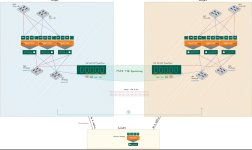
Has anyone implemented and tested this combination of Stretched Proxmox Cluster with Dell Powerstore Metro?
Regarding to this article - Metrovolume should work fine with FC or iSCSI (LVM thick):
https://infohub.delltechnologies.com/en-au/l/dell-powerstore-metro-volume-1/introduction-5117/
PowerStoreOS 4.0 adds the support of SCSI-3 reservations and registrations for Metro Volume, enabling it to be used in a standalone Linux host and clustered Linux hosts configuration.
PowerStore manages the synchronization of data and SCSI reservations across PowerStore clusters. In addition, PowerStoreOS 4.0 allows grouping several volumes into a single Metro Volume Group, allowing them to be managed in a logical unit.
Metro Volume is a storage-level feature that requires no modifications to the Linux hosts or applications. It is a stretched volume spanning across two PowerStore clusters. Each Metro Volume consists of two volumes, one on each cluster, synchronized bi-directionally over a replication network.
Important to consider for the 3rd site (Tiebreaker):
Unlike corosync itself, a QDevice connects to the cluster over TCP/IP. The daemon can also run outside the LAN of the cluster and isn’t limited to the low latencies requirements of corosync (<5ms)
If the QNet daemon itself fails, no other node may fail or the cluster immediately loses quorum. For example, in a cluster with 15 nodes, 7 could fail before the cluster becomes inquorate. But, if a QDevice is configured here and it itself fails,
no single node of the 15 may fail. The QDevice acts almost as a single point of failure in this case
BR




 That should be on tshirts and hammered into the brains of all mankind.