

Hi,
we are currently designing a relativelly small HA infrastructure and would appreciate some opinions from experienced Proxmox users.
Our infrastructure consists of:
We are currently discussing two possible architectures:
Scenario 1:
Create one cluster consisting of C1, C2, S1, S2 and W1, with a 3-of-5 quorum. S1 and S2 would also provide compute resources in addition to their storage role.
Scenario 2:
Keep the roles separated: C1 + C2 with W1/QDevice as the Proxmox compute cluster, while S1 + S2 form a separate storage HA cluster using DRBD/TrueNAS.
The main discussion is whether the additional compute capacity and 3-of-5 quorum of Scenario 1 provide a real HA advantage, or whether separating compute and storage as in Scenario 2 provides better fault isolation and a more robust architecture.
I would be interested in your experience and opinions, particularly regarding the advantages/disadvantages, quorum behavior, failure scenarios, maintenance, and potential risks of running Proxmox workloads on the storage nodes.
Which architecture would you recommend for a production HA environment, and why?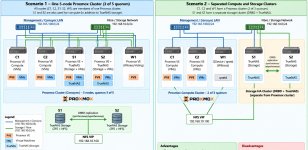
we are currently designing a relativelly small HA infrastructure and would appreciate some opinions from experienced Proxmox users.
Our infrastructure consists of:
- C1, C2 – Proxmox compute servers
- S1, S2 – TrueNAS storage servers providing NFS, with DRBD replication
- W1 – separate witness/voting node
- All servers are connected through a dedicated fibre network (internal) as well as a regular LAN.
We are currently discussing two possible architectures:
Scenario 1:
Create one cluster consisting of C1, C2, S1, S2 and W1, with a 3-of-5 quorum. S1 and S2 would also provide compute resources in addition to their storage role.
Scenario 2:
Keep the roles separated: C1 + C2 with W1/QDevice as the Proxmox compute cluster, while S1 + S2 form a separate storage HA cluster using DRBD/TrueNAS.
The main discussion is whether the additional compute capacity and 3-of-5 quorum of Scenario 1 provide a real HA advantage, or whether separating compute and storage as in Scenario 2 provides better fault isolation and a more robust architecture.
I would be interested in your experience and opinions, particularly regarding the advantages/disadvantages, quorum behavior, failure scenarios, maintenance, and potential risks of running Proxmox workloads on the storage nodes.
Which architecture would you recommend for a production HA environment, and why?


