A cluster file system should remain stable, even in case of hardware failure.
How do the heck do you get a split-brain with
It is a Distributed-Replicate volume 3x9. gvol???
It's a (distributed) replicate gvol.
Therefore; copies of the data are replicated across the bricks, so how would you even
get split-brain with a replicated volume?
I don't understand how that's possible.
Furthermore, Erik wrote that it's a distributed-replicate volume 3x9, but from his
gluster volume info, the output of that shows:
Code:
Volume Name: cm_shared
Type: Distributed-Replicate
Volume ID: e7f2796b-7a94-41ab-a07d-bdce4900c731
Status: Started
Snapshot Count: 0
Number of Bricks: 3 x 3 = 9
I did read that thread and the point is that there was data unavailability that simply allows the OS to continue in a corrupted state. They didn’t know why only that it happens under load. The point of a cluster file system is that it continues working flawlessly even if you pull a network cable or an entire node down.
lol.....you're clearly
not on the ceph mailing list, are you?
People have been reporting all sorts of issues with ceph.
ceph isn't immune to issues, just because it's ceph.
I've been on the ceph mailing list since March 9th, and in just the last three months, that folder, in my email, has 221 emails in there, where the issues are quite diverse.
You seem to present ceph as though issues like these
only happen with gluster and that issues doesn't happen with ceph, when, as the mailing list shows, is far from the realities of ceph deployments where ceph isn't immune to data unavailability as well. This isn't just a gluster issue. It can happen with ceph as well.
(cf.
here,
here, and
here as well.)
If you read the thread, then you would've read that Erik stated that they fixed the problem that had nothing to do with gluster itself anymore than if you have a bad drive capable, which causes data corruption, would be the cause of whatever HW RAID system you were using, at the time.
Again, as I've cited, ZFS
will commit corrupted data to stable storage if you have bad drive cables and/or issues with the IMC where ZFS won't know that it is commiting corrupted data to disk.
That'd like you blaiming gluster = bad because of a bad network cable, where if you
fixed said bad network cable, then your gluster problem goes away.
Cuz that's what Erik from HPE wrote, which if you read that, then you would've known this rather than saying, quote;
"Similar split brain scenarios under heavy (note that for today's standards, this is no longer heavy, Ceph can hit 1M 64kB IOPS across 12 nodes) load was reported before on mailing lists in 2019 with Gluster 4
https://lists.gluster.org/pipermail//gluster-users/2019-September/037083.html It is a very similar problem to what I started seeing 15 years ago as our cluster grew, split brains started occurring. Yes, you can throw more CPU, hardware and do optimizations, but at some point, you get to a point that it is untenable, a file system that throws up its hands in I/O error is BAD."
Erik, in his reply to
Ravishankar N at Redhat,
literally tells you this.
But that's
not what you wrote in the quote from you above.
If you read the thread and knew it, then that's knowingly making fraudulent claims/statements about gluster that you [i[know[/i] were fraudulent misrepresentations.
Therefore; given what you wrote, I would have to give you the benefit of the doubt where you
didn't read said thread.
So which is it? You read the thread and then made
knowingly fraudulent misrepresentations anyways, or you didn't read the thread, which is why you wrote what you wrote?
So which is it?
This is primarily because there are no developers able or willing to work on it
From the commentary from others, that's not the claimed reason why.
The claimed reason why is that they were looking at the relative
lack of activity, but contrary to people's claims (that are then promulgated and repeated elsewhere like here), gluster has active developers even if the pace of commits isn't as active as a project that has a lot of problems that i needs to patch.
I mean, that's the
easiest way to boost the number of commits per month. Have (or introduce) a lot of bugs that you have to fix. You can push the commit/month metric through the roof when you have a lot of bugs to fix.
(cf.
Nvidia drivers)
that are ancient, like e1000 and even netware era NIC, as long as it works or someone maintains it.
Just out of curiosity - how many commits have there been for the e1000 NIC driver within any timeframe?
Plugins don’t just drop into the system, you seem very confused about how these things work in general but no, the plugin is not just writing files to an NFS/FUSE mount. It leverages Gluster Block support.
Again, as it has been noted, you can mount the glustefs with the
glusterfs-client package (in the case of Proxmox, from the Debian repo). Therefore; so long as the GUI/plugin is to provide a graphical front end for said
glusterfs-client package, which already exists on Debian, and as
@kayson mentioned, Debian's newest package supports gluster 11.2, therefore; so long as
Debian supports it, the plugin can just be the graphical front end that sets up or passes the user input arguments to the
glusterfs-client to mount a gluster volume.
Said gluster block support is already provided via
glusterfs-client.
You think that I'm confused and yet, you haven't been able to provide
any citations that shows that I'm wrong (about how the
glusterfs-client works).
As to the rest of your comment, you’re reading things that aren’t there, it’s called the Dunning-Kruger effect.
More often than not, the people who cite Dunning-Kruger
completely fail to realise that there's an entire right-side of the Dunning-Kruger effect plot that they often times, generally and convenient ignore.
(Ironically enough, and since you mention it -- you're still on the
left side of your citation of the Dunning-Kruger effect where you think you know more about ceph than the ceph devs. This is a literal and practical demonstration of your reference of said Dunning-Kruger effect where you don't even know what you don't know.)
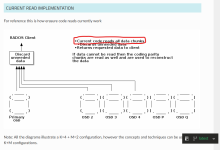
It's literally right there.
LOL...LMAO....
I can't help if you're unable to read (or too lazy to read -- can't really tell at this point whether it's a question of ability or whether it's a question of laziness and/or both.)
You should understand what the Ceph developer writes when it comes to CRUSH or ask ChatGPT to explain how it scales vs AFR/DHT-based systems.
Or...you can just read what I've drawn the red box around from the ceph documentation that the ceph devs have authored.
My point on Windows is that you cannot reliably benchmark it if you don’t understand the underlying architecture. It doesn’t matter what your benchmark shows because you’re not testing the storage layer, but the CPU and RAM.
1) Translation: you're too embarrassed to disclose what hardware/software you're using. Which is fine, because after all your complaining about it, what this means is that the hardware that you're running in your homelab would be susceptible to
your own complaints about said hardware which is why you're embarrassed to disclose what hardware/software you're using.
2) You're embarrassed to have someone else replicate your tests because if someone else dares tries and am able to generate data that contradict your claims -- well, you just can't have that.
3) You will critique what WIndows/NTFS does all day long, but then do nothing about "fixing" it (because in reality, the vast majority of Windows users doesn't GAF. And by market share, Windows is still
the dominant desktop OS, by far, which also means that if the issues that you've raised were really as serious as you make them sound, they would've been fixed a long time ago, because too many people would have lost their data because of how Windows/NTFS behaves. And yet, that's clearly not the case here.
Millions/billions of people have been using Windows just fine just as millions/billions of users don't care about the points that you've brought up (about how Windows/NTFS quote "lies" to you given that it works "well enough" for said millions/billions of users.
So, it's a whole lot of nothing burger.
4) You can't prescribe/produce a script where you'd be able to put a VM in such a state to generate the workload that you're using
fio to test with/generate, even though you claim that Windows can do it.
So, if Wndows is able to generate/produce that kind of a workload, then why bother using
fio???
Heck, use Linux for all I care (given your complaining about Windows).
According to you, any modern OS would be able to generate that kind of a workload, so then why don't you just use quote "any modern OS" for the load generation rather than
fio if you claim that any modern OS can generate that kind of a load???
If it can do it, then why aren't you testing it with it then??? Seems so simple.
And for the record, I re-ran CrystalDiskMark 24 hours and 40 minutes later and this is what I got;
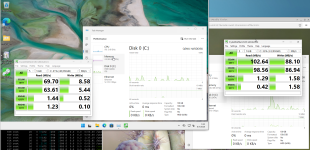
You argue that it can't be tested reliably and yet, the maximum stdev (in MB/s) was 4.13657 MB/s and the min stdev was 0 MB/s. As a percentage of the average stdev/mean was 2.28% for gluster and 3.94% for ceph (because it was so slow, that small differences in the results yielded a higher stdev, and therefore; as a percent of the average, the slow results of ceph made it more sensitive to variations.
Either way, I could run it over and over again to obtain the population statistics, but the relatively low stdev already shows that it will pass a gauge R&R.
I have controlled for those in my test, to do so on Windows would require significant work.
What you see on the host side isn't necessarily what you're going to see, from inside a VM.
You argue that you had to cap the network at 400 Mbps meanwhile I installed 3 Win11 VMs, on the gluster cluster, without any issues. (System was RAM limited such that I couldn't spawn a 4th gluster node, and then spawn a 4th Win11 VM.)
You said that it would split-brain under quote "a heavy workload" (which is why you tested with
fio --iodepth=32 --numjobs=4 --nrfiles=128) and yet running three Win11 installs ran without any hitches and I didn't bother neutering the virtio-nic so that it will be able to run at full speed.
In other words, your
synthetic workload is precisely that -
synthetic. It isn't a "real" workload of Windows (or Linux since complainers have to always complain about something) that would be more realistic and more representative of what an actual client would be running or can run.
Again, I don't need any tricks nor do anything special/extra.
Just install and go let the post-install Win11 updates do Win11 update things.
You could automate the install and testing with DISM.
I ran my testing/benchmarking the way that I have because it is
designed to be so simple that
anybody could repeat the tests since there's hardly anything to it.
Point your VM to the Win11 ISO and run through the process of creating said VM and then once it is all set up, just let Win11 updates to Win11 update things.
This is performed this way, because this is what Win11 installs are like. Nobody bothers customising anything (in terms of how NTFS reports drive statistics back to the user because no one GAF).
It's what people
do.
And by purposely running the tests this way, it means that any can repeat the test, just as I didn't bother tuning ceph/gluster neither.
Install and go.
This is what the experience is when you just deploy ceph/gluster/Win11 VM "out of the box". This is what you get.