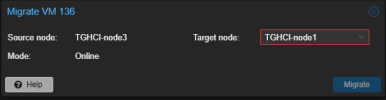
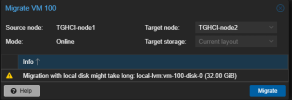
). And access to the migration's target storage when using local storage is assumed as important, because chances are good that storage differs from node to node.
Why is it designed like this, and what is the original intention of the design? What are the considerations for transferring Ceph storage to local lvm?Hi Tinwen!
This is the current default behaviour for vm-disks stored on network-storage. You'll find the same effect if you put your disks onto NFS eg. So migrating the storage to a local one would be a two-step process:
1) Do the live migration to your desired node
2) Visit node->vm->hardware, find your disk and move the storage to a local one through the 'Disk Action' Dropdown Menu.
I guess that the design assumes you're good, once you have your disks on shared storage (which is very likely true if you have CEPH rbd on a fast network
That's what I wanted to ask you in the first place -- I just picked up the local-lvm storage possibility because I saw it in your screenshotWhat are the considerations for transferring Ceph storage to local lvm?

Difficult to say. What I could imagine, is that systems get upscaled by growing needs. Even if PVE makes running CEPH a breeze, a CEPH cluster by itself is quite sophisticated regarding storage engineering. So I can understand developers not expecting people running their images on network storage to have the need of a oneclick-drop-the-image on local-storage-XY on node-NN functionality (as a twoclick one already exists).Why is it designed like this, and what is the original intention of the design?
Maybe try to migrate the volumes one by one at:What are the considerations for transferring Ceph storage to local lvm?
We use essential cookies to make this site work, and optional cookies to enhance your experience.