

Anzeige PVE-Dashboard
- Thread starter TErxleben
- Start date
You are using an out of date browser. It may not display this or other websites correctly.
You should upgrade or use an alternative browser.
You should upgrade or use an alternative browser.

Ich weiß nicht so ganz wie man diese Frage interpretieren soll.

So klarer?Ich weiß nicht so ganz wie man diese Frage interpretieren soll.
Würdest Du hier auch mal suchen (geht auch locker via Google) -> https://forum.proxmox.com/threads/understanding-cpu-usage-and-server-load.73692/
Dann hättest auch Fabian's Link gesehen ..... https://www.brendangregg.com/blog/2017-08-08/linux-load-averages.html
Schaut unter Linux HTOP so aus:

Sommerloch? Langeweile? Gedankenspiele?
Dann hättest auch Fabian's Link gesehen ..... https://www.brendangregg.com/blog/2017-08-08/linux-load-averages.html
Schaut unter Linux HTOP so aus:
Sommerloch? Langeweile? Gedankenspiele?
Last edited:
Weder noch.Würdest Du hier auch mal suchen (geht auch locker via Google) -> https://forum.proxmox.com/threads/understanding-cpu-usage-and-server-load.73692/
Dann hättest auch Fabian's Link gesehen ..... https://www.brendangregg.com/blog/2017-08-08/linux-load-averages.html
Schaut unter Linux HTOP so aus:
View attachment 98459
Sommerloch? Langeweile? Gedankenspiele?
Ein satt 10J alter Beitrag von Brendan hilft da auch nichts. Hier geht es um Anzeigen in der PVE-GUI! Die findet hier mit keinerlei Einheit und ganz ohner Erklärung statt.
Sondern es sind nur hingerotze Zahlen, die man in keine Relation setzen kann.
Das schon die htop-Anzeige unterirdisch ist, muss nicht dazu führen, diese Werte unbewertet zu übernehmen.
Wie bewertest du denn einen htop-Wert von 1.21 auf einem Rechner, der Däumchen dreht?
Last edited:
Sag mal, das ist ja alles schön und gut, was dich da gerade so umtreibt.Ein satt 10J alter Beitrag von Brendan hilft da auch nichts. Hier geht es um Anzeigen in der PVE-GUI! Die findet hier mit keinerlei Einheit und ganz ohner Erklärung statt.
Sondern es sind nur hingerotze Zahlen, die man in keine Relation setzen kann.
Das schon die htop-Anzeige unterirdisch ist, muss nicht dazu führen, diese Werte unbewertet zu übernehmen.
Zum einen sind die Werte von HTOP mit Sicherheit die selben wie in der GUI (unterstelle ich jetzt einfach einmal).
Da stellt sich mir die Frage, warum ein 10 Jahre alter Artikel "überholt" sein soll - wir sind hier bei Linux und nicht bei dem M$ Windows System. Und Selbst dort hält sich das altgebackene taufrisch.
Ich schau mir diese eigentlich nicht an - es ist schön das es die gibt. Und es mag durchaus seine Da-Sein Berechtigung haben. Gebraucht habe ich die noch nie, ich störe mich aber auch nicht an der Darstellung!Wie bewertest du denn einen htop-Wert von 1.21 auf einem Rechner, der Däumchen dreht?
Ob das das jetzt "unterirdisch" oder "dahingerotzt" ist - ist deine persönliche Empfindung. Das hat weder Hand noch Fuß!
Last edited:
Generell ist die LOAD bei Linux eine etwas "silly metric" (so die Linuxkernelentwickler: https://github.com/torvalds/linux/blob/master/kernel/sched/loadavg.c ), da sie eben nicht nur CPU-Auslastung sondern auch andere Sachen wie IO berücksichtigt, zum Anderen aber eben einen Wert über die letzten 5/10/15 Minuten darstellt, der je nach sonstigen Systemparametern (eine Load von 5 bei 15 Prozessoren ist harmlos, bei 1 dagegen hoch bedenklich) mehr oder weniger hilfreich sein kann. Darum hat das Nagios-Plugin auch einen Switch, um den Wert durch Anzahl der CPUs zu teilen, um die Werte etwas sinnvoller zu kriegen. Auch das sagt ohne Kontext aber nur wenig aus: Wenn ich einmal am Tag (weil dann z.b. ab 23:00 Uhr ein fetter Job zum OCRen eines Haufens gescannter Dokumente läuft, die tagsüber reingekommen sind) die Werte hochgehen, muss das ja nicht weh tun. Tagsüber wenn z.B. Sachbearbeiter erwarten über den gleichen Server auf diese Scans zuzugreifen dagegen schon.
In neueren Linux-Kerneln gibt es darum ja die Load Pressure Metriken, die deutlich hilfreicher sind (und auch im PVE-Dashboard ablesbar), die sagen nämlich aus, wie lange Prozesse im Schnitt auf angeforderte Ressourcen (CPU, RAM, IO) warten mussten: https://www.linux-magazin.de/ausgaben/2020/08/psi/
Zur CPU Load und anderen silly metrics gab es bei der Fosdem2024 auch einen erfreulich kurzen (< 30 Minuten) Vortrag: https://archive.fosdem.org/2024/sch...1-linux-load-average-and-other-silly-metrics/
Und (ja ich bin Fanboy) Kristian Koehntopp hat im Laufe der Jahre auch einiges zur Load und wofür sie brauchbar ist und wofür nicht geschrieben:
https://blog.koehntopp.info/2005/06/24/wieviel-load-darf-es-denn-sein/
https://blog.koehntopp.info/2012/08/28/load-load-testing-und-benchmarks/
https://blog.koehntopp.info/2020/06/08/waffle-house-index-of-tooling/
Bei begrenzter Zeit reicht es den letzten Artikel zu lesen, bei sehr begrenzter Zeit dessen conclusio:
Mit anderen Worten: Statt sich über zu hohe Last alamieren zu lassen, sollte man eher anhand der Produktion ermitteln bis zu welcher Last die Workloads noch vertretbare Reaktionszeiten liefern und sobald sie dies nicht mehr tun dann automatisiert z.B. der VM zusätzliche Ressourcen zuweisen oder neue VMs als Worker provisionieren. Darum ist es auch durchaus sinnvoll die Load zu überwachen, aber eben nicht für Alarme, die gehen dann nämlich entweder ständig los (wenn du gerade genug Ressourcen hast wie du brauchst und kaum weniger, also bei jeden Spike) oder zu spät Problem: Das setzt sehr viel "Versuch und Irrtum" bei gleichzeitigen Messen in der Produktion (Testumgebungen sind einfach nie verlässlich) voraus, was wiederum eine eigene Wurmkanne/Kaninchenbau ist
Ohne sinnvolles Monitoring (und nein das PVE Dashboard ist das nicht) kann man da kaum was machen.
In neueren Linux-Kerneln gibt es darum ja die Load Pressure Metriken, die deutlich hilfreicher sind (und auch im PVE-Dashboard ablesbar), die sagen nämlich aus, wie lange Prozesse im Schnitt auf angeforderte Ressourcen (CPU, RAM, IO) warten mussten: https://www.linux-magazin.de/ausgaben/2020/08/psi/
Zur CPU Load und anderen silly metrics gab es bei der Fosdem2024 auch einen erfreulich kurzen (< 30 Minuten) Vortrag: https://archive.fosdem.org/2024/sch...1-linux-load-average-and-other-silly-metrics/
Und (ja ich bin Fanboy) Kristian Koehntopp hat im Laufe der Jahre auch einiges zur Load und wofür sie brauchbar ist und wofür nicht geschrieben:
https://blog.koehntopp.info/2005/06/24/wieviel-load-darf-es-denn-sein/
https://blog.koehntopp.info/2012/08/28/load-load-testing-und-benchmarks/
https://blog.koehntopp.info/2020/06/08/waffle-house-index-of-tooling/
Bei begrenzter Zeit reicht es den letzten Artikel zu lesen, bei sehr begrenzter Zeit dessen conclusio:
TL;DR
and
- If CPU load alerting worked, reactive autoscaling would work, too.
- In a web workload environment, it usually doesn’t.
- If you experiment, you need to attribute cost and benefit to experiment variants.
- That means load tests with production users.
- That means detailed, many-dimensional metrics with many tags, and a lot of ad-hoc metrics exploration.
- Once you have that, you are also ready for predictive autoscaling, which actually works.
Kristian Koehntopp https://blog.koehntopp.info/2020/06/08/waffle-house-index-of-tooling/
- If your shop uses CPU load alerting, chances are that their tooling and education is in need of emergency updating.
Mit anderen Worten: Statt sich über zu hohe Last alamieren zu lassen, sollte man eher anhand der Produktion ermitteln bis zu welcher Last die Workloads noch vertretbare Reaktionszeiten liefern und sobald sie dies nicht mehr tun dann automatisiert z.B. der VM zusätzliche Ressourcen zuweisen oder neue VMs als Worker provisionieren. Darum ist es auch durchaus sinnvoll die Load zu überwachen, aber eben nicht für Alarme, die gehen dann nämlich entweder ständig los (wenn du gerade genug Ressourcen hast wie du brauchst und kaum weniger, also bei jeden Spike) oder zu spät
Problem: Das setzt sehr viel "Versuch und Irrtum" bei gleichzeitigen Messen in der Produktion (Testumgebungen sind einfach nie verlässlich) voraus, was wiederum eine eigene Wurmkanne/Kaninchenbau ist Ohne sinnvolles Monitoring (und nein das PVE Dashboard ist das nicht) kann man da kaum was machen.
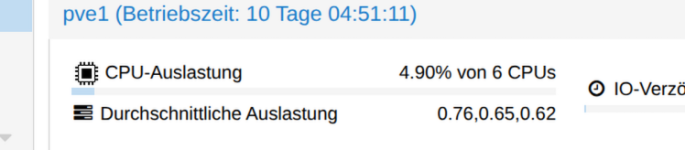
Die drei Zahlen sind der klassische Load Average aus
Zum Einordnen musst du es gegen deine CPU-Anzahl rechnen, bei dir 6 Kerne. 0.76 heißt also: im Schnitt nicht mal ein Kern voll beschäftigt, der Rest dreht Däumchen, völlig entspannt. Kritisch wirds erst, wenn der 15min-Wert dauerhaft über deine Kernzahl klettert. Und ja, die Metrik ist ziemlich grob, für echte Engpässe sind die Pressure/PSI-Werte aussagekräftiger, die @Johannes S oben schon verlinkt hat.
/proc/loadavg, also die 1/5/15-Minuten-Mittel. Das sind keine Prozent-Werte, sondern grob die Anzahl Prozesse, die laufen wollen oder im uninterruptible IO-Wait hängen. PVE zeigt da einfach 1:1 den Kernel-Wert an, nichts Eigenes.Zum Einordnen musst du es gegen deine CPU-Anzahl rechnen, bei dir 6 Kerne. 0.76 heißt also: im Schnitt nicht mal ein Kern voll beschäftigt, der Rest dreht Däumchen, völlig entspannt. Kritisch wirds erst, wenn der 15min-Wert dauerhaft über deine Kernzahl klettert. Und ja, die Metrik ist ziemlich grob, für echte Engpässe sind die Pressure/PSI-Werte aussagekräftiger, die @Johannes S oben schon verlinkt hat.
Mich stören nur die Inkonsistenzen in der Übersichtsanzeige.
Der eine Wert heißt oben auf der Seite "Durchschnittliche Auslastung". Der dazugehörige Graph heißt "Serverlast".
Ein anderer heißt oben "RAM-Auslastung" und der zugehörige Graph "Speicherverbrauch".
Mag piselottig klingen, verwirrt aber zumindest mich und wäre extrem einfach anzupassen.
Der eine Wert heißt oben auf der Seite "Durchschnittliche Auslastung". Der dazugehörige Graph heißt "Serverlast".
Ein anderer heißt oben "RAM-Auslastung" und der zugehörige Graph "Speicherverbrauch".
Mag piselottig klingen, verwirrt aber zumindest mich und wäre extrem einfach anzupassen.
Stimmt schon, das ist inkonsistent, im Header steht ein Begriff und der Graph heißt anders. Liegt teils an der deutschen Übersetzung, teils ist es schon im englischen Original so (
Wenn dich das stört, mach am besten einen Eintrag auf https://bugzilla.proxmox.com auf (Kategorie GUI), sowas wird da auch angenommen wenns nur Kosmetik ist. Die Übersetzungen lassen sich relativ leicht anpassen, falls du Lust hast selbst nen Patch übers Proxmox-Translation-Repo beizusteuern.
Load average vs Server Load). Nerviges Detail, aber kein Bug im eigentlichen Sinn.Wenn dich das stört, mach am besten einen Eintrag auf https://bugzilla.proxmox.com auf (Kategorie GUI), sowas wird da auch angenommen wenns nur Kosmetik ist. Die Übersetzungen lassen sich relativ leicht anpassen, falls du Lust hast selbst nen Patch übers Proxmox-Translation-Repo beizusteuern.